Furries, therians, and people who practice petplay have spent the past few years serving as a punchline, a political talking point, and an occasional moral panic. Very little of that coverage has involved talking to anyone who is actually a furry, a therian, or a petplay practitioner. Almost none of it has involved reading the research, which has existed for close to two decades.
This article walks through what each term means, how these communities overlap, how they differ from one another, what studies of these communities have found, and where the most common myths came from. If you’re here because you’re curious about yourself, or because someone you care about just told you something you weren’t expecting, that’s a good reason to keep reading.
Fandom, Identity, or Roleplay? A Quick Comparison
Furry, therian, and petplay tend to show up in the same sentence, usually in a headline, a school board meeting, or a worried text from a relative. That grouping is a little unfair to all three. One is a fandom, one is an identity, and one is a form of roleplay. They overlap at the edges, and plenty of people belong to more than one, but they answer completely different questions about a person.
Here’s the short version before we get into each one.
| Furry | Therian | Petplay | |
| What it is | A fandom | An identity | A form of roleplay |
| The question it answers | What do you enjoy? | Who are you? | What are you doing? |
| Inherently sexual? | No | No | Often, but not always |
| Overlap | Some furries are therians | Many therians are in the furry fandom | Participants may be either or neither |
The overlap is real, which is part of why these terms get tangled together. A therian may well be part of the furry fandom, and someone who enjoys petplay might have a fursona too. What doesn’t follow is the assumption that one of these tells you anything reliable about the other two.
The sections below take each one in turn, along with the questions people most often ask, including the ones they’re usually too polite to ask out loud.
Furries
What is a furry?
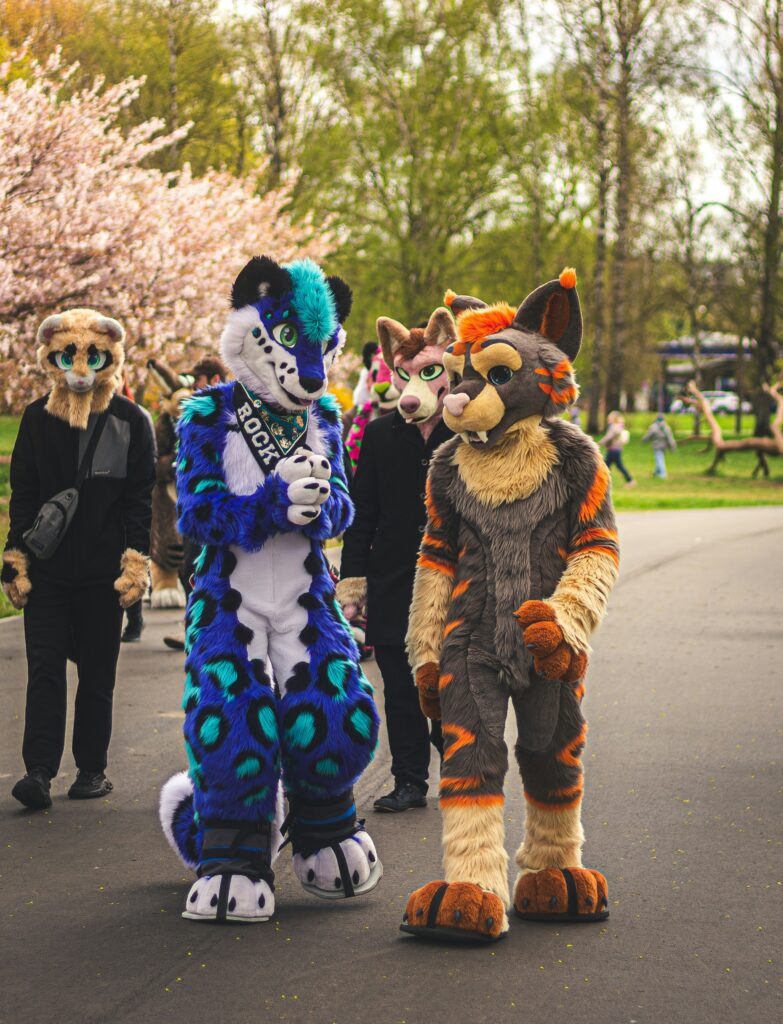
At its most basic, “furry” just means a person is a member of the furry fandom. These are people who enjoy art, stories, and other media featuring anthropomorphic characters (Gerbasi et al, 2008). This is an incredibly wide umbrella! While the stereotype of a furry may be someone attending a convention in a full-body suit, a child designing their Sonic the Hedgehog original character or a fan of Donald Duck comics is just as much a part of the fandom. Someone wearing a fursuit is not inherently different from someone wearing a costume of their favorite hero at a comic convention, or their favorite athlete’s jersey.
Are furries a sexual thing?
The idea that furries are inherently sexual, participating in zoophilia or engaging in mass orgies, is a negative stereotype (Roberts et al., 2015). Like with any fandom, there is a portion of people who engage in erotic writing, art, and roleplay. For most furries, the motivating factor for joining the fandom was a sense of belonging and entertainment (Plante et al., 2016).
It also cannot be ignored that furries, as a group, are more likely to be LGBTQ+ than the general population. Exact statistics vary from study to study. In one sample, 28% of male furries identified as straight (compared to 31.5% gay and 40.5% bi), and the female furries were split at 58% straight and 42% bi (Gerbasi et al., 2008). Other studies have found furries are, compared to other fandoms (such as sports or anime fans), 2-6 times more likely to self-identify as bisexual and 3-10 times more likely to self-identify as exclusively homosexual, as well as 7 times more likely to identify as homosexual compared to the general population (Plante et al., 2016). Given such statistics, it can be difficult to tease apart where the stereotypes of furries as perverted, deviant or hypersexual overlap with homophobic stereotypes.
Do furries want to be animals?
People who identify intrinsically as animals are better labeled as “Therians”, which we will get to in the section below. Since the furry fandom allows for self-expression and roleplay as an animal-self, it can be quite appealing to therians, and there is overlap between the two groups (Plante et al., 2016). But overall, the majority of furries identify as 100% human (Gerbasi et al. 2008).
Therians
What is a therian?
A therian is a person who identifies as an animal on an internal or integral level (Bricker, 2016).
“Otherkin” is a related term for people who identify as nonhuman that historically developed separately, but now shares a lot of overlap (Scribner, 2012). Some therians identify as another species instead of human; others see it as a both-and identity. The creature one identifies with can be anything, from cat to sea slug. The reasons people identify this way also vary. Some see it as a quirk of neurology, others as a spiritual experience (such as having the soul of an animal, or a significant past life).
Is being a therian a mental illness?
Therians perceive their species identity as internal and often emphasize that it is not physical– they know they are not literally transforming into a werewolf (Bricker, 2016). This isn’t a transient symptom or a temporary phase; there are therians in their sixties (Clegg et al., 2019). Like other identities, people’s self-identification as a therian tends to emerge in adolescence, solidify, and persist through adulthood (Bricker, 2016). Nor is it inherently negative, dangerous, or harmful. The largest study of otherkin/therian mental health to date found that “There were no differences in mental health outcomes between nonhuman- and human-identified participants” (Bricker, 2024).
Won’t this get used against trans people?
When transphobes make ‘attack helicopter’ jokes, people may feel wary toward a group that might seem to confirm that stereotype. Studies of therians as a population often do find reports of species dysphoria, a sense of discomfort or disconnect from one’s human body (Gerbasi et al., 2008). The therians reporting this sense of dysphoria are not doing it to make fun of trans people; they’re expressing their own lived experiences.
In fact, a great many therians are transgender themselves (even more so than the disproportionately LGBTQ+ furry community). In one study, 11% of otherkin and 14% of therians identified as transgender (Gerbasi et al., 2017). Of those that experienced both, a majority (79%) indicated a connection between their gender and species identities (Bricker, 2024).
Transphobic bad actors will use any excuse to marginalize those they see as deviant. If such an excuse doesn’t actually exist, they will make one up, such as the completely fabricated hoax that schools had litter boxes for “furry”/therian students (Baska, 2022). Much as anti-drag laws often fail to distinguish between trans identity, drag as a performance, and just different clothing styles, conservative politicians are pushing for “anti-furry” bills in schools that are deliberately broad to cover both gender and species identity, to police student expression and behavior (89(R) History for HB 4814 | Texas Legislature Online, n.d.). Therians are not the cause of these measures- they are just fellow targets being thrown under the bus.
Petplay
What is petplay?
Petplay is a form of roleplay where one or more partners take on the role of a pet, and another plays as the owner or handler (Pet Play Explained, n.d.). The animal could be anything, though domestic pets like dogs, cats, and horses are the most common. The partners in a petplay scenario don’t necessarily identify as animals in their day-to-day lives, or have any particular interest in animal media, any more than any other roleplay scenario.
Is petplay always sexual?
As a part of the BDSM umbrella, petplay is often sexual, but doesn’t have to be. For many people, the fun comes from the aspects of power dynamics– obedience and disobedience, being cared for or caring for another person, having or giving up control. Petplay practitioners also report things like relaxation, self-expression, and building relationships/community as important motivators for play (Langdridge & Lawson, 2019).
Kink-Affirming Care: Talking about kink shouldn’t mean explaining yourself first. Learn about our Kink-Friendly Sex Therapy.
When to Seek Support & What Affirming Therapy Looks Like
Membership and exploration of these communities is often a support in and of itself! Research indicates engagement with the furry community helps members explore their identity, develop social skills, and receive emotional support (Roberts et al., 2015). Likewise, research on therians indicates it is best approached as diversity, not disorder (Clegg et al., 2019). So right off the bat, someone being a member of these communities is not a reason to need clinical intervention, and in fact may be an important part of someone’s support system.
A furry, therian or petplay practitioner may seek mental health support for reasons completely unrelated to their identity or label – anything from depression to adjusting to a new job. Once they are in the therapy room, though, it is important that they be accepted! This aspect of someone’s identity can be just as significant and important to them as their religious beliefs or sexual orientation, and should be treated with the same degree of respect (Roberts et al., 2015). This also applies to support for petplay, and other forms of kink and BDSM. A therapist or social worker encountering these groups should be aware of stereotypes and internal biases, and help their clients move toward self-determination (Williams, n.d.). In short, a furry, therian, or kink practitioner shouldn’t feel they have to hide this aspect of themselves when getting help, and an affirming therapist will be accepting rather than pathologizing or trying to fix or correct these identities.
Finding a Kink- and Alterhuman-Affirming Therapist in Chicago
Here at Best Therapies, we believe a client shouldn’t have to explain what a fursona is before they can talk about their anxiety, or worry that mentioning kink will get pathologized in their chart. Many of our providers are familiar with the alterhuman, furry, and kink communities. Some are even members themselves! These providers are available at Chicago Locations and via Telehealth throughout Illinois.
Specialists:
Vilte Baliutaviciute
Both professional and lived experience as a member of the therian/otherkin, furry, and kink communities.
https://staging.besttherapies.org/staff/vilte-baliutaviciute/
Locations: In person in Andersonville; telehealth in Illinois
Kai Korpak
Professional experience with all three, lived experience in kink and petplay.
https://staging.besttherapies.org/staff/kai-korpak/
Locations: Telehealth in Illinois, California, Colorado, and Minnesota
Jamie Warren
Professional experience with all three.
https://staging.besttherapies.org/staff/jamie-warren/
Locations: In person in Lakeview; telehealth in Illinois
Key Takeaways
Let’s put it all together! Furries are people who are fans of art, movies, books, and shows with anthropomorphic animal characters. Therians are people who internally identify as animals. Petplay is a form of kinky roleplay, playing pretend as a partner’s pet. These communities overlap, but aren’t all the same thing. Broadly, they tend to lean more LGBTQ+ than the average population, and are often low-hanging fruit for people seeking a political punching bag or a scandalous headline.
All three communities are not inherently negative; in fact, the opposite is true, with these communities and identities improving people’s mental health and well-being. So, the person wearing a fur tail and an animal ear headband isn’t the big bad wolf here to knock down the community– they are a vital and vulnerable part of it.
Sources
89(R) History for HB 4814 | Texas Legislature Online. (n.d.). Retrieved April 22, 2026, from https://capitol.texas.gov/BillLookup/History.aspx?LegSess=89R&Bill=HB4814
Baska, M. (2022, January 25). School official denies litter boxes were given to students who identify as furries. PinkNews | Latest Lesbian, Gay, Bi and Trans News | LGBTQ+ News. https://www.thepinknews.com/2022/01/25/furries-litter-boxes-students-school-michigan/
Bricker, N. (2016). Life Stories of Therianthropes: An Analysis of Nonhuman Identity in a Narrative Identity Model. https://www.academia.edu/34647048/Life_Stories_of_Therianthropes_An_Analysis_of_Nonhuman_Identity_in_a_Narrative_Identity_Model
Bricker, N. L. (2024). Mental Health and Well-Being of Nonhuman-Identified Individuals: The Role of Minority Stress and Resilience [Doctoral Dissertation, Palo Alto University].
Clegg, H., Collings, R., & Roxburgh, E. C. (2019). Therianthropy: Wellbeing, Schizotypy, and Autism in Individuals Who Self-Identify as Non-Human. Society & Animals, 27(4), 403–426. https://doi.org/10.1163/15685306-12341540
Gerbasi, K., Bernstein, P., Conway, S., Scaletta, L., Privitera, A., Paolone, N., & Higner, J. (2008). Furries from A to Z (Anthropomorphism to Zoomorphism). Society & Animals, 16(3), 197–222. https://doi.org/10.1163/156853008X323376
Langdridge, D., & Lawson, J. (2019). The Psychology of Puppy Play: A Phenomenological Investigation. Archives of Sexual Behavior, 48(7), 2201–2215. https://doi.org/10.1007/s10508-019-01476-1
Pet Play Explained: Fetish 101 | HUD App. (n.d.). Retrieved August 25, 2026, from https://www.hudapp.com/blog/fetish-101-pet-play
Plante, C. M., Reysen, S., Roberts, S. E., & Gerbasi, K. C. (2016). FurScience! A Summary of Five Years of Research from the International Anthropomorphic Research Project. Furscience. https://furscience.com/wp-content/uploads/2017/10/Fur-Science-Final-pdf-for-Website_2017_10_18.pdf
Roberts, S. E., Plante, C., Gerbasi, K., & Reysen, S. (2015). Clinical Interaction with Anthropomorphic Phenomenon: Notes for Health Professionals about Interacting with Clients Who Possess This Unusual Identity. Health & Social Work, 40(2), e42–e50. https://doi.org/10.1093/hsw/hlv020
Scribner, O. (2012). Otherkin timeline: The recent history of elfin, fae, and animal people (2.0). The Art and Writing of O. Scribner. http://frameacloud.com/wp-content/uploads/2015/01/Scribner_Timeline2p0.pdf
Williams, D. J. (n.d.). Social Work, BDSM, and Vampires: Toward Empowering People with Non-Traditional Identities. https://www.academia.edu/11532033/Social_Work_BDSM_and_Vampires_Toward_Empowering_People_with_Non_Traditional_Identities